Join Us at Youth IGF Nepal 2026 and APrIGF 2026: Two Conversations on a Safer Internet

Every day, people in Nepal face harm online that the tools built to protect them were never designed to see. This October, Open Knowledge Foundation Nepal is joining two forums at the Royal Tulip Kathmandu to start conversations about closing those gaps, from the language of online abuse to the way algorithms shape young minds.
Youth IGF Nepal 2026
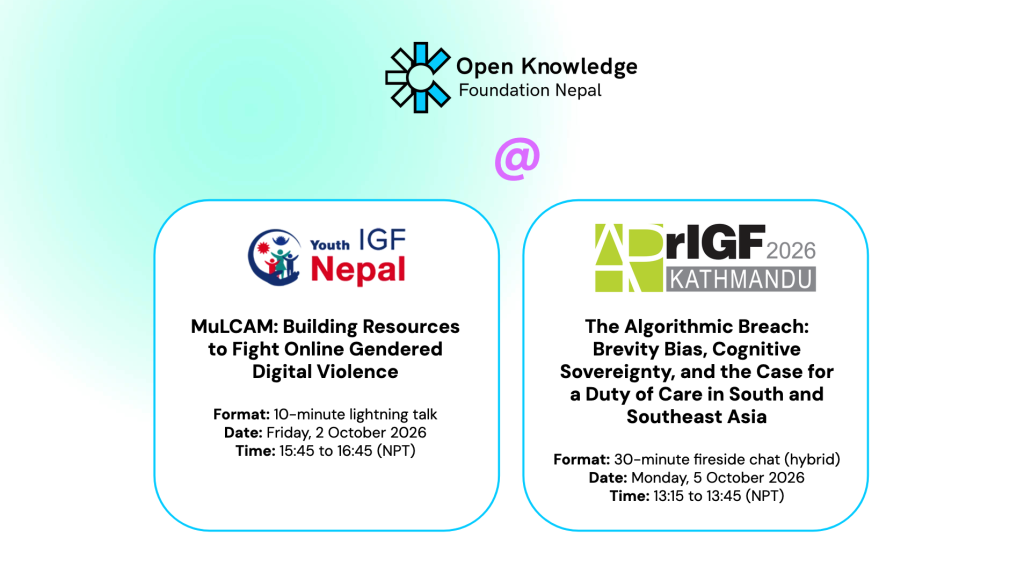
- Session: MuLCAM: Building Resources to Fight Online Gendered Digital Violence
- Format: 10-minute lightning talk
- Date: Friday, 2 October 2026
- Time: 15:45 to 16:45 (NPT)
- Venue: Royal Tulip Kathmandu
- Speaker: James Shrestha, Chief Operating Officer, Open Knowledge Foundation Nepal
Youth IGF Nepal 2026 is a full-day, youth-led, multi-stakeholder forum bringing together young people, civil society, government, the technical community, and the private sector to discuss the future of the internet in Nepal.
As social media use grows rapidly in Nepal, so does the violence that flows through it. Most global moderation systems are trained on English and cannot recognize Nepali slurs, Romanized Nepali insults, or coded harassment in languages like Newari, Bhojpuri, Tharu, and Tamang. MuLCAM (Multilingual Corpus and Moderation) is Nepal’s first open, context-aware linguistic corpus focused on technology-facilitated gender-based violence, built through community contributions across Nepal’s languages and scripts.
In this lightning talk, we will share how the corpus is being built, what it takes to document harmful language responsibly, and how youth, developers, and researchers can contribute to Nepal’s digital safety infrastructure.
Learn more on the Youth IGF Nepal 2026 website.
Asia Pacific Regional Internet Governance Forum (APrIGF) 2026
- Session: The Algorithmic Breach: Brevity Bias, Cognitive Sovereignty, and the Case for a Duty of Care in South and Southeast Asia
- Format: 30-minute fireside chat (hybrid)
- Date: Monday, 5 October 2026
- Time: 13:15 to 13:45 (NPT)
- Venue: Royal Tulip Kathmandu, and online
- Speakers: Priya Lamichhane, Legal Researcher and Co-founder, Open Knowledge Foundation Nepal; Nhasala Joshi, Co-founder, Open Knowledge Foundation Nepal
The 17th Asia Pacific Regional Internet Governance Forum takes place from 4 to 7 October 2026 under the theme “Safeguarding a Resilient Internet in Times of Crisis.”
Child safety online is usually discussed in terms of what children see. This session asks a different question: what does the way content is delivered do to a developing mind? Drawing on original research across South and Southeast Asia, we will look at how platform algorithms favor ultra-short content, where current child protection laws in the region fall short, and a proposed “Cognitive Duty of Care” as a path toward regional cooperation.
Learn more on the APrIGF 2026 website.
Who Should Join
Both sessions are open to civil society organizations, youth advocates, researchers, policymakers, educators, journalists, technologists, and anyone who cares about safer, more inclusive digital spaces. No technical background is needed.
See You There
We look forward to meeting you at the Royal Tulip Kathmandu. Come say hello, join the conversation, and help us build a safer internet for everyone.