Introducing Nagarik Niti: Making Nepal’s Laws Easier to Follow, and Easier to Shape

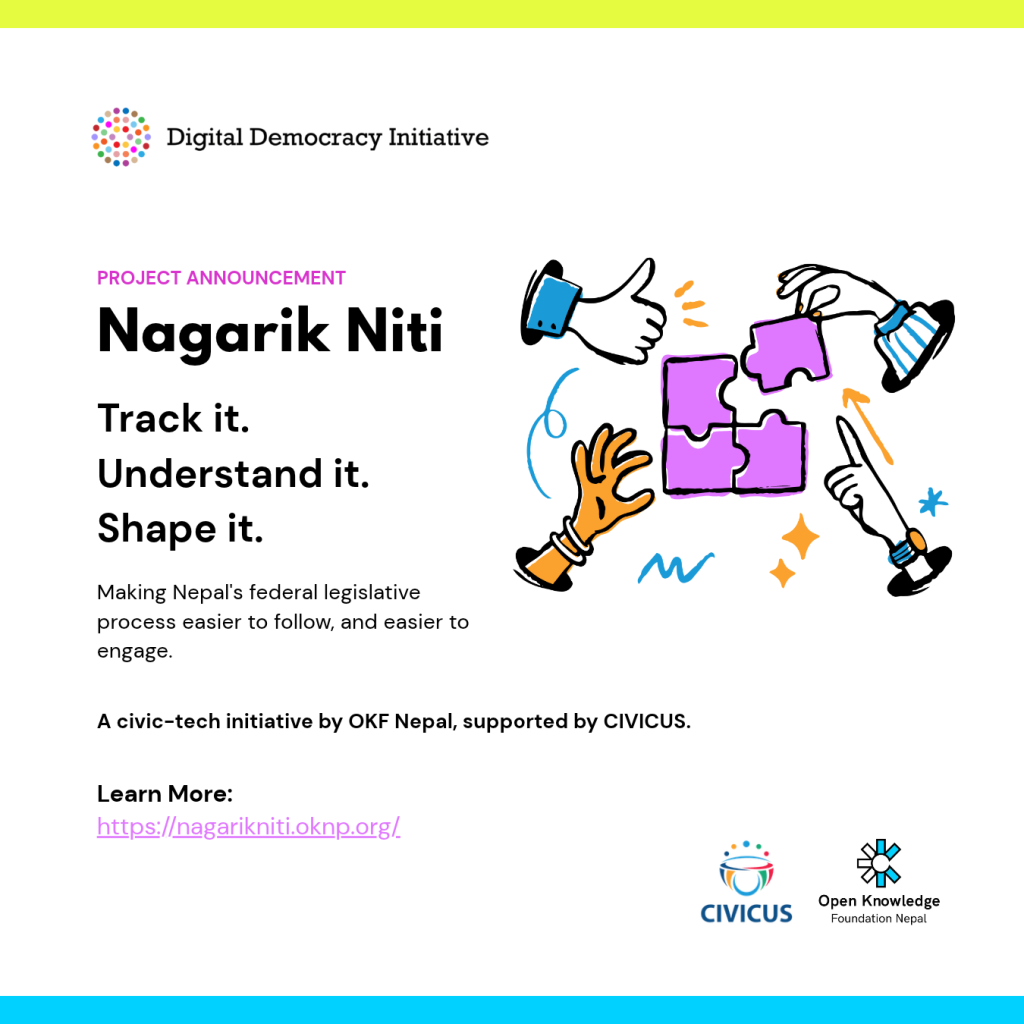
Open Knowledge Foundation Nepal (OKF Nepal) has begun work on Nagarik Niti, a bilingual platform that makes Nepal’s federal legislative process understandable and open to participation for everyday citizens.
OKF Nepal is a non-profit civic tech organization that advances open knowledge as a design principle beyond data. We believe open information enables participatory governance, and through research, advocacy, training, and tools, we work so that everyone in Nepal has free and open access to the information they need to make informed decisions. Nagarik Niti brings that belief to lawmaking, where the information that shapes daily life is often hardest to read and act on. Our aim is to make Nepal’s laws easier to understand, and to give citizens a real way to take part in shaping them.
The project is supported by the Digital Action Lab (DAL) of CIVICUS, the World Alliance for Citizen Participation, where we are one of 15 organizations in DAL Cohort 3. In July 2026, we joined the cohort’s co-creation workshop in Nairobi to pressure-test the project’s design with fellow organizations and the CIVICUS team. We are now moving from planning into full implementation.
Why Nagarik Niti
Nepal’s legislative process is public in theory. In practice, following a bill means wading through dense legal language, cross-referencing existing law, and working out where and how to make your voice heard. Bills are rarely available in plain Nepali, comment windows are short and poorly publicized, and tracing how a bill connects to existing law usually takes legal expertise. For most people, civic participation quietly stops there.
The will to participate already exists in Nepal. What has been missing is accessible infrastructure, and that is what we are building.
What we’re building
Nagarik Niti brings four connected pieces together on a public, ongoing record that keeps growing, bill after bill:
- Policy Tracker: follows each bill from registration to passage.
- Plain-language summaries: explain, in Nepali and English, what a bill proposes, changes, and affects.
- Legal reference map: shows which existing laws a bill amends or replaces.
- Structured input tool: turns citizen responses, anonymous if preferred, into a formal report delivered to decision-makers.
AI helps draft the first pass of each summary, but a named validator reviews and signs off before anything is published. Technology makes legislative information legible at scale, and accountability for what it says stays with people.
Nine months, and who we want to build it with
Between September 2026 and May 2027, we will lay the groundwork (mapping active organizations and running a baseline survey on legislative awareness), build the platform module by module, then preview it with partners, launch publicly with onboarding sessions across Kathmandu Valley, and measure what changed. We will share a public citizen engagement report and a learning report at the end.
We are looking for three kinds of partners:
- Policy and research organizations working on legislative, legal, and civic accountability, who can help validate content and connect us with the people most affected.
- Technologists and AI practitioners working on law, governance, or civic data, who can help us summarize legal language responsibly and keep an AI-assisted process auditable.
- Youth and student organizations, who can help us reach and onboard first-time users directly. Young people are our primary audience, as the most active in Nepal’s digital life and the most underrepresented in its formal legislative process.
If your organization fits any of these, we’d like to talk.
Where this goes next
For this first phase, Nagarik Niti covers only Nepal’s federal legislative process, where a working baseline of legal text and record already exists. Provincial and local lawmaking matters just as much, but that information is far more fragmented, and we would rather build a solid model at one level than a thin one across three. If the model works, natural next steps include provincial assemblies, cross-bill and cross-year tracking, and structured data access for journalists and researchers.
Want updates as we build, or interested in becoming a validator or partner? Visit the project page to get notified at launch, or write to us at info@oknp.org.