Stop Searching, Start Asking: AI Integration is Now Live on Open Data Nepal

When we relaunched Open Data Nepal (ODN) in October 2025, we set out a bold roadmap, a vision of what a truly intelligent, accessible, and community-driven open data platform could look like for Nepal. Among the priorities we outlined were a AI chatbot for natural-language data exploration, seamless data publishing, and experimental AI integrations through the Model Context Protocol (MCP).
Today, we are excited to announce that we are delivering on that promise.
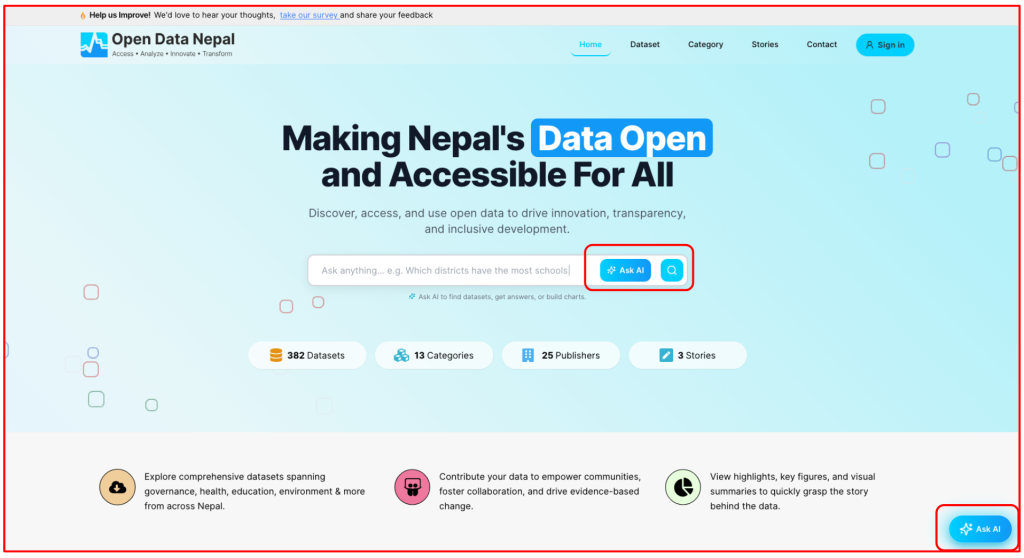
AI integration is now live on Open Data Nepal — bringing AI-powered data discovery, definition, and insight generation directly to anyone who visits the platform. Alongside this AI integration, we have also shipped Seamless Publishing and a Comprehensive Data Explorer, both of which we cover in detail in this blog post.
From Blueprint to Reality
In our October 2025 relaunch blog, we wrote: “As we continue to expand and refine Open Data Nepal, we’re committed to pushing the boundaries of accessibility, intelligence, and collaboration.”
The AI integration we are launching today is the most meaningful step in that direction yet. It brings conversational, context-aware data exploration to the platform, making Nepal’s public datasets accessible to anyone, regardless of technical background.
What Is the AI Integration
Open Data Nepal now features a conversational AI assistant embedded directly into the platform. Rather than navigating through categories, applying filters, or manually browsing dataset pages, users can now simply ask a question — in plain English — and receive an intelligent, contextual response.
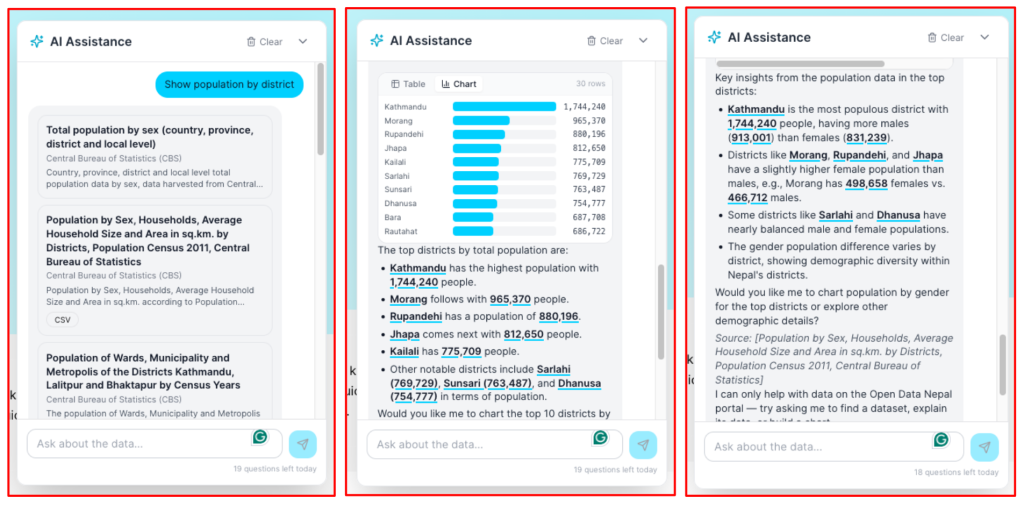
A floating “AI Assistance” button is available throughout the portal. Whether you are on the homepage, browsing an organization’s datasets, or reading a dataset page, the assistant is always within reach. It understands the context of the page you are viewing, which means its responses are grounded in the actual data available on Open Data Nepal, not generic answers from the internet.
The assistant is powered by GPT-4.1-mini, which we have fine-tuned to understand the structure of Open Data Nepal, including how datasets, organizations, metadata, and groups are organized on the portal. This fine-tuning is what allows the assistant to give precise, relevant answers rather than generic responses.
Three Core Capabilities
1. Data Discovery
Finding the right dataset has always been a challenge, especially for users who are not sure what to search for or how the data is categorized. The AI assistant removes that barrier entirely.
Ask the assistant something like:
- What datasets are available about climate change in Nepal?
- Is there data on school enrollment by district?
- Which organizations have published health data?
The assistant searches across all datasets on the platform and surfaces the most relevant results instantly. No manual browsing. No guesswork.
2. Data Definition
Open data is only useful if users understand what it means. Column names, metadata fields, data sources, and coverage areas can be confusing, especially for journalists, students, or citizens who are not data specialists.
The AI assistant helps users understand what a dataset actually contains. Ask it:
- What does this dataset measure?
- What does the ‘HH_Size’ column mean?
- How frequently is this data updated and who published it?
The assistant explains datasets in plain language, making Nepal’s public data genuinely accessible, not just technically available.
3. Data Interpretation and Insights
The most powerful capability of the AI integration is its ability to go beyond discovery and definition, all the way to insight.
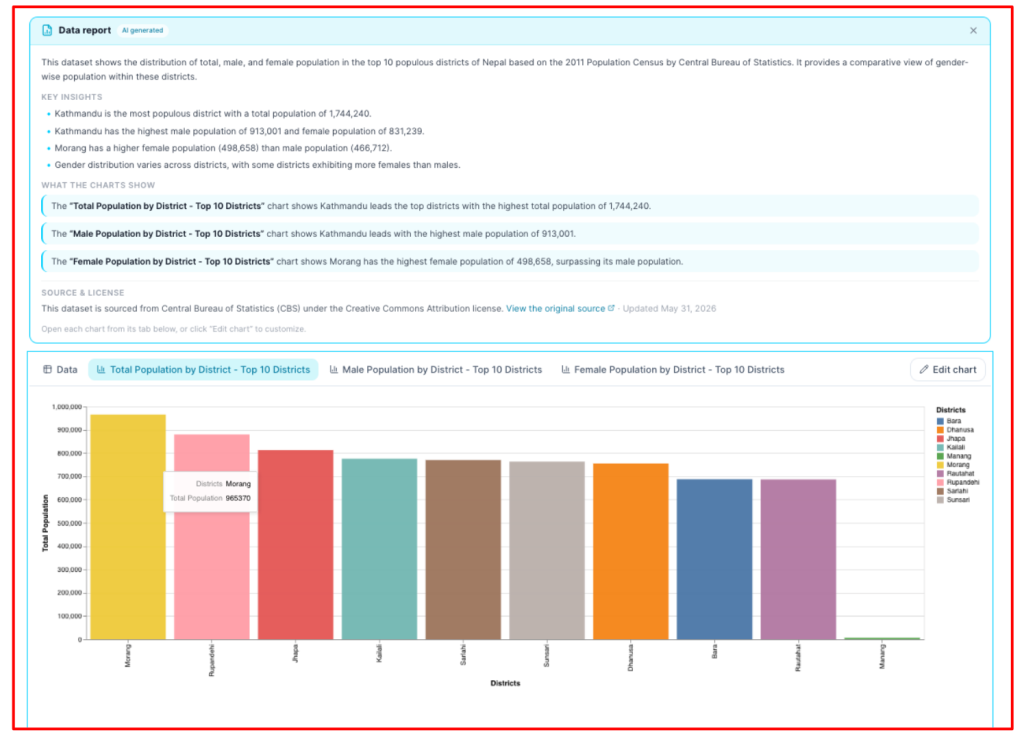
Users can ask the assistant to analyze a dataset, compare indicators, or generate a chart, and receive a structured response complete with visualizations. For example:
- Show me the top five districts by population density.
- Compare literacy rates across provinces.
- Create a chart from the agriculture production data.
Going from “question → insight → visualization” now takes seconds, without downloading files, opening spreadsheets, or writing a single line of code.
Why This Matters for Nepal
Nepal’s open data ecosystem has grown significantly over the past decade. Datasets spanning governance, health, education, agriculture, environment, and more are now published and freely accessible. But access alone is not enough.
The gap between data availability and data usability has always been real, and it disproportionately affects the people who could benefit most: local journalists, civil society researchers, government officials at the ward and municipal level, and citizens who have a right to understand public information.
The AI integration at Open Data Nepal is designed to close that gap. By making data conversational, contextual, and visual, it puts the power of Nepal’s open data into the hands of anyone, regardless of their technical background.
What’s Still on the Horizon
This launch is a significant milestone, but not the finish line. We continue to develop:
- Interactive Dashboards: compare datasets, explore trends, and track development indicators in real time.
- Community Governance: shared models for dataset curation, validation, and storytelling
- MCP Integrations: deeper AI-assisted workflows connecting Open Data Nepal with external tools and platforms.
Nepal’s data is open. Now, it is also intelligent.