When Algorithm Decides: What Nepal’s Digital Creators Are Up Against

Every day, algorithms make decisions about what Nepali voices can say online. Most of these decisions happen in milliseconds, inside systems built far from Nepal, trained mostly in English, and accountable to no one here. The people affected rarely find out why. They often cannot appeal. And there is no one to call.
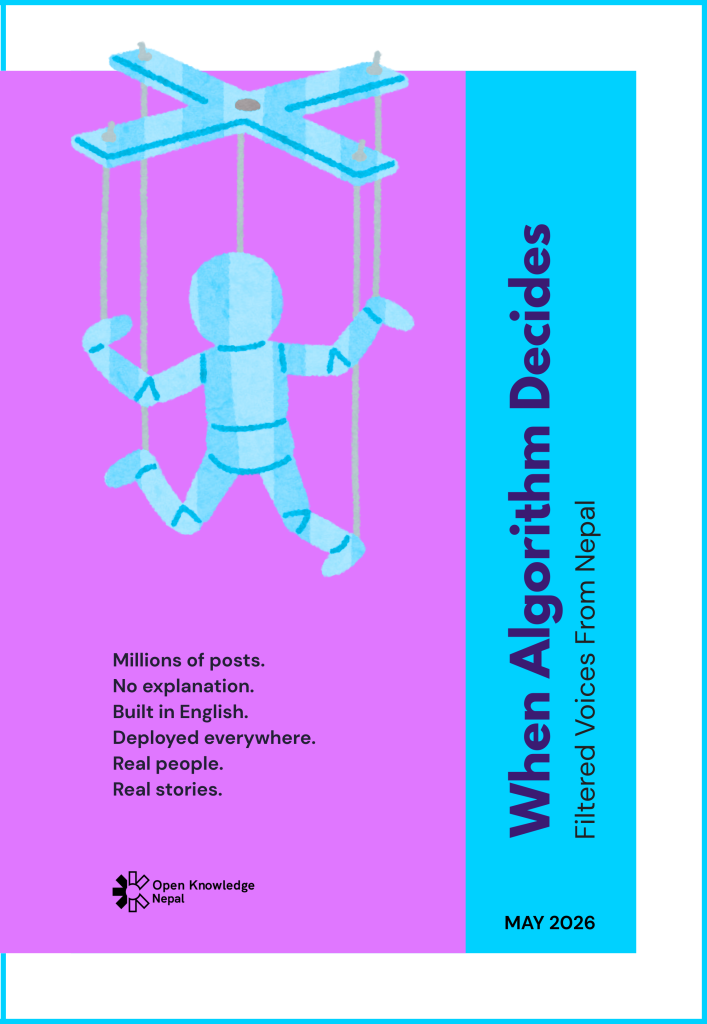
This is the story of our new zine, When Algorithm Decides: Filtered Voices from Nepal, set out to document.
The Scale of the Problem
The numbers alone are striking. TikTok removed nearly 1.9 million pieces of content from Nepal in Q4 2025. YouTube placed Nepal among the top 25 countries globally for content removals during the same period, despite Nepal having a significantly smaller economy and digital footprint than most countries on that list. Meta, the most widely used platform in Nepal with over 14 million Facebook users and 3.9 million Instagram users, removed 271 million posts globally in Q4 2025 while publishing zero Nepal-specific enforcement data.
What the platforms tell us about these removals: almost nothing. No breakdown by language. No case-level reasoning. No information on how to appeal. No explanation of what triggered the decision or how to avoid it next time.
What is missing from that data is not a technical gap. It is a choice.
Nepal Is Not an Exception. It Is a Pattern.
Research across Africa, Latin America, South Asia, and the Middle East documents the same dynamic: automated moderation systems built primarily in English, deployed globally, and consistently failing communities across the Global South. A systematic review of 16 studies found that automated systems silence marginalized groups not randomly, but structurally. Shared AI components across platforms mean that if your content is suppressed on one platform, it is more likely to be suppressed across all of them.
Communities speaking Tamil, Quechua, Kiswahili, and Maghrebi Arabic have learned to post in their own languages specifically because content in those languages is less likely to be caught by automated systems. Posting in your mother tongue as a survival strategy is not a workaround. It is evidence that something is badly wrong.
Nepal sits inside this same pattern. The language is different. The outcome is the same.
Five Stories That Put a Face to the Numbers
In March 2026, Open Knowledge Nepal brought together creators, journalists, and activists in Kathmandu to talk about what platform moderation actually looks like from the inside. Here is what they described.
- The creator who was shadow-banned without ever being told: A content creator running multiple brand accounts on TikTok and Instagram had built real reach. A video about a government issue crossed one lakh views. Then, across two or three posts, her numbers collapsed, not because the content had changed, but because TikTok quietly stopped distributing it to new audiences. No notification. No removal. No warning. She figured it out by watching her own analytics over weeks. Later, she received a call from what she understood to be TikTok’s regional office offering hashtag suggestions, confirming that her account had been individually monitored. No one explained why it had been suppressed.
- The journalist who learned which words were dangerous by trial and error: A YouTube journalist covering public interest news had his monetization switched off when he reported on a rape case involving Nepali students in India, a story that was major national news and covered widely by journalists across the country. The topic classifier flagged it as unsuitable for advertising. Over time, he developed his own system: substituting “w*r” for the English word “war” and using censored versions of Nepali words in thumbnails. He learned the rules not because the platform told him, but by watching what got flagged and adjusting.
- The creator who watched democracy flicker: In September 2025, Nepal blocked 26 platforms including Instagram, Facebook, and WhatsApp without warning. A civic content creator with active brand partnerships lost her income the same day the platforms went dark. No transition period. No compensation. When Instagram came back, what she felt was not relief. It was the unsettling recognition that it had felt like relief, which meant something important had been in danger.
- The queer advocate whose community lost its infrastructure: Queer community members in Nepal had long relied on pseudonymous profiles for safety. Those profiles were flagged and removed, not because of anything they posted, but because the profiles themselves triggered automated systems. A dating platform that had served queer communities safely was banned around 2013-2014. No alternative was offered. The result, compounded by a pervasive sense that certain content is monitored by government-adjacent communications teams, is a digital space where self-censorship is not driven by a rule you can point to. It is driven by knowing that certain things should not be said.
- The lifestyle creator who wants one thing from Meta, a person: A creator with roughly 85% Nepal and India-based followers has built her audience despite structural disadvantages, not because of them. Audio tracks available globally arrive months late or not at all in Nepal. Instagram views in Nepal do not count toward earnings the same way they do elsewhere. When her content was caught in moderation decisions she did not expect, she found no process, no dedicated authority, and a form that no one could confirm would work. Her recommendation is not a policy. Not a bill. A person. Someone at Meta whose job is Nepal.
Three Gaps Behind Every Finding
The zine identifies three structural problems that run through all of the evidence.
- The transparency gap means platforms remove millions of Nepali posts annually without publishing the data needed to evaluate whether those removals are accurate, linguistically fair, or politically neutral. In the EU, Meta publishes algorithmic transparency reports and complaint data under regulatory pressure. In Nepal, there are only global aggregates.
- The language gap means that automated systems were not trained on Nepali, Maithili, or Newari. The consequences fall entirely on Nepali creators and communities, not on the platforms that built and deployed those systems.
- The accountability gap means there is no dedicated authority in Nepal, no local platform contact, and no institutional channel. When something goes wrong, there is a form. No one knows if it works.
What You Can Do
You do not need institutional power to start making this visible. Document moderation decisions when they happen: screenshot the removal, write down the platform, the date, and the reason given. Appeal, even when it feels pointless, because platforms track appeal rates and low rates are read as low dissatisfaction. Talk about it. The stories in this zine exist because people were willing to share them.
Every documented incident is evidence. Evidence is what changes systems.
Read the full zine, download it, and share it: https://oknp.org/resources/when-algorithm-decides